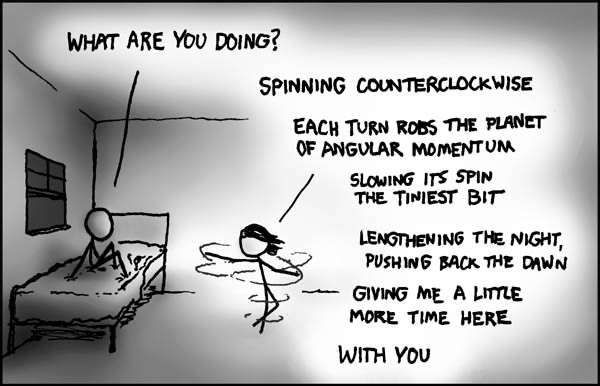
Some things in life completely strip away your footing. They leave you feeling entirely, helplessly out of control. When that happens, the natural human instinct is to fight back, to grab onto whatever levers are in reach. Sometimes you exert control by making choices that aren’t the most optimum, or even healthy. But it’s all about control, isn’t it? We humans want it, chase it and do desperate things just to feel a shred of it. We lose ourselves in pursuit of it; amazing and terrifying this humanity of ours.
In the past few days, I have made choices and done things simply to exert control, things I won’t go into detail about here. But this post is about the concept itself. Mathematicians like to be in control. We like to set up a system, play around with the variables and trace the outcomes down to the last decimal point. We crave logical predictability and want to know that if x changes, y will respond in a way we can calculate.
So why is so much of philosophy and survival about letting go of what you can’t control?
Control gives us the illusion of autonomy and power. Choice is control, or at least control over something. Even when a choice is chaotic, making it feels like proof that you are still the operator of your own life. This brings me to a paradox: Is the choice to let go, then, an act of control too?
If you consciously decide to stop fighting the wave and to drop the variables, or to let the system run its course without forcing an outcome, are you surrendering, or are you executing the ultimate form of agency? Why do we lust for control so badly? Why do we become victims to our own desire to master the unmasterable?
Asking ‘why’ and wanting answers only progresses you so far. Knowing why your hand is burning on a hot stove doesn’t take your hand off the stove1. Analysing the thermodynamics of the heat won’t stop the damage and intellectualising the pain doesn’t extinguish the fire; you can’t think your way out of a visceral, physical burn while keeping your hand flat on the surface. To actually move your hand, you have to shift your entire frame of reference.
In vector calculus, when an integral in standard Cartesian coordinates becomes an absolute nightmare, it’s often helpful to perform a change of variables2. You transform to polar, cylindrical, or spherical coordinates to align with the domain’s inherent symmetry and suddenly, what seemed impossible in one coordinate system becomes elegant and integrable in another.
I want to argue that real control isn’t keeping your hand on the stove while analysing the burn in Cartesian space but making the choice to change the coordinate system. It is recognising that you don’t have to evaluate an impossible domain alone through sheer force when there are existing structures, symmetries and people built to help carry the integration. Choosing to step away from the noise or simply sit outside on a bench and listen to the sound of grass3 isn’t losing control.
We lust for control because we want safety, but safety cannot come from forcing a chaotic world into a rigid grid while we burn. We’ve got to pull our hand off the stove.