Before last week, it had been over two years since I last took a flight to India. As standard, my phone and laptop synced automatically to the local time zone. My watch, which was also supposed to sync automatically, didn’t.
Usually, when a piece of tech acts up, you just feel a flash of annoyance, fix it, and move on. But it got me thinking about what actually happens when we step across a border and change our clocks. I couldn’t help but imagine how a lot of us (including myself!) might take it for granted that time is this seamless, digital stream flowing across the planet.
As it turns out after a bit of going through various rabbit holes, the way we map time across the globe is a fascinating and chaotic compromise between geometry and history.
The Earth is a sphere (roughly1) spinning 360 degrees on its axis every 24 hours. If you divide 360 by 24, you get 15 degrees of longitude equalling one hour of the sun moving across the sky. So in a world run purely by mathematical purists, the planet would be sliced into 24 vertical wedges and every time you walked 15 degrees east or west, you’d step over an invisible boundary line and click your watch forward or backward by exactly one hour.
But as anyone who has ever looked at a modern time zone map knows, humans don’t really do neat vertical lines. Instead of a perfect geometric layout, we live on a grid governed by Coordinated Universal Time (UTC), which is actually kept in line by incredibly precise atomic clocks2.
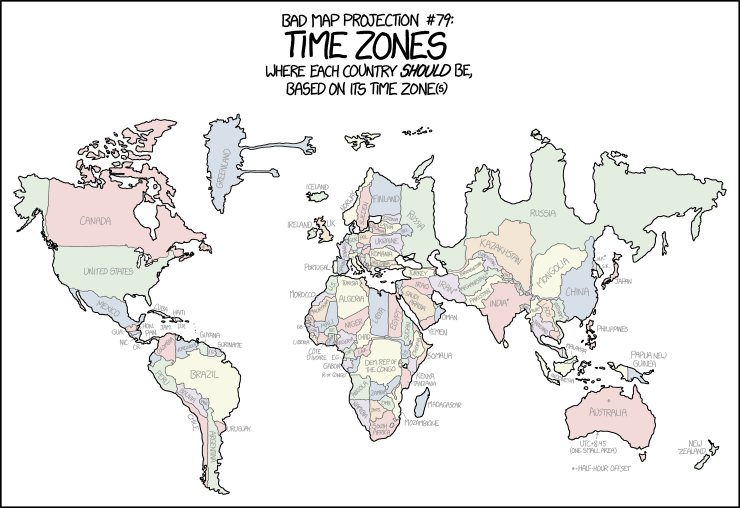
Take my flight to India as an example. If you follow the standard one-hour intervals, you’d expect the subcontinent to fall neatly into one of the whole-hour zones. But it doesn’t; India runs on UTC+5:30. Before independence in 1947, the British administration ran the country on two primary hubs: Bombay Time and Calcutta Time. But a newly independent nation needed a singular identity. To avoid favouring one major economic city over the other, the government took the average of the two and thus the Indian Standard Time (IST) standard decided to split the difference down the 82.5° E longitude line passing right through Mirzapur.
India is far from the only place where geography loses the battle to human and political practicality. Mathematically, China is huge enough to span five distinct geographical time zones. Before 1949, it actually behaved logically, utilizing offsets ranging from UTC+5.5 to UTC+8.5. But when Chairman Mao Zedong consolidated power and formed the People’s Republic of China, he saw those five lines as symbols of a fragmented nation. In a radical act of political centralisation, he decreed that the entire country would operate exclusively on Beijing Time (UTC+8). In China’s far western province of Xinjiang, the sun routinely rises at 10:00 AM3 and sets near midnight.
On the complete opposite end of this spectrum sits Russia, which covers roughly 11% of the Earth’s landmass. It stretches so far from east to west that the country is sliced into a staggering 11 different time zones. When a programmer in Kaliningrad is closing their laptop at 6:00 PM, a fisherman in Kamchatka is waking up at 4:00 AM the next calendar day.
Managing a country across 11 zones is an administrative nightmare, and Russia actually tried to out maths geography in 2010. In a bid to “tighten economic integration,” the government overnight abolished two entire time zones, shrinking the count to 9. The experiment failed spectacularly; people in the far regions woke up in freezing darkness, public outcry ensued and by 2014, Russia gave up trying to trick the sun, returning to the 11 zone system we see today.
The universe may run on pure maths. Humans, unfortunately for my wrist, run on politics.
- I say roughly a sphere because if you want to get pedantic, the Earth is technically an oblate spheroid. ↩︎
- Specifically, UTC is tracked by about 400 atomic clocks globally. They measure the exact frequency of microwave emissions from electrons changing energy levels in caesium atoms. It is accurate to one second every 300 million years. ↩︎
- One can only imagine the the local population running an unofficial, community led clock two hours behind the state mandate just so they aren’t eating breakfast in the pitch black ↩︎

