I picked up crochet again a few weeks ago, after over a year of not touching it. For a while I was made to feel like it wasn’t a worthwhile use of my time, and eventually I just put it down. Picking it back up has reminded me how grounding it is. There’s something about the rhythm1 of the process of hook in, yarn over, pull through, that makes your brain go quiet in a way that’s hard to find elsewhere.
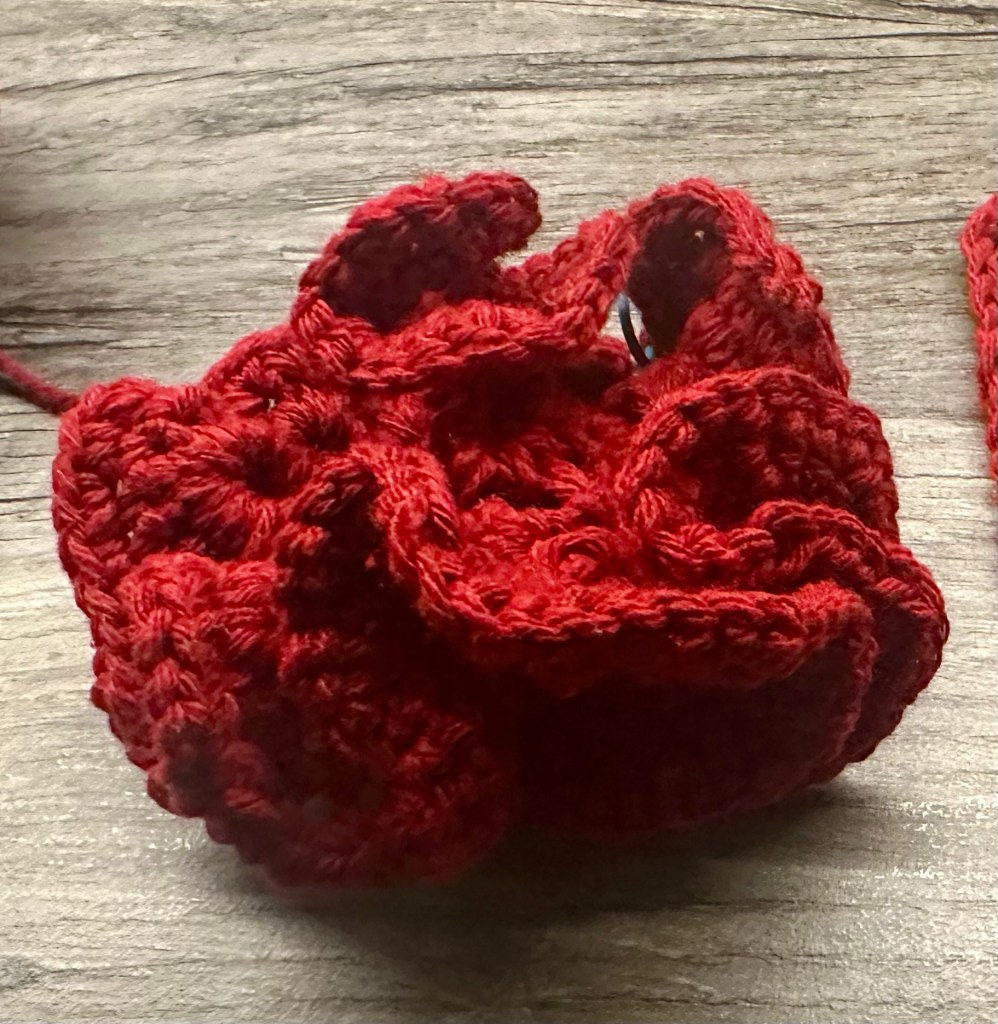
This isn’t actually my first hyperbolic surface. Last year I started on a project (pictured on the left), and called it ‘Hector: my hyperbolic emotional support demon‘.2 Hector made it through a few rows before life got complicated, and somewhere between moving houses and going back and forth to university, he’s gone missing until further notice– or, more poetically, has transcended into a higher dimensional space which our minds simply cannot access.
So this project is Hector II: The Return of the Ruffle. Part of the reason I’ve picked up crocheting again is that I’m volunteering for a week at the UKMT National Mathematics Summer School in early August. I’ve been looking into a selection of mathematical crafts and games for the evening activities, and playing around with a hyperbolic surface felt like the kind of thing to bring. Something you can hold, look at, and immediately have questions about.
A hyperbolic surface, it turns out, is one of those mathematical objects that sounds intimidating until you’re holding one in your hands. The way you make one out of yarn is fairly simple: you increase stitches at a fixed rate. This raises an obvious question: why does increasing stitches produce a hyperbolic surface?
Think about crocheting a flat circle. You add stitches at exactly the rate needed to keep the fabric lying flat, so the circumference grows at just the right pace to match the radius. In Euclidean geometry, the circumference of a circle is exactly 2πr, and your stitch count tracks that perfectly. When you increase faster than that (eg every other stitch, in the case of Hector II) you’re adding more circumference than a flat surface needs. The fabric has too much material to lie flat, so it has no choice but to curve! That excess circumference is exactly what hyperbolic geometry is: a surface where circumference grows faster than 2πr as you move outward from a point.
Mathematicians measure this using something called Gaussian curvature. A flat surface has Gaussian curvature zero; a sphere has positive Gaussian curvature (think of how the surface curves back on itself); a hyperbolic surface has negative Gaussian curvature, meaning it curves AWAY from itself in every direction, which is what produces all that ruffling. So how often you increase changes how much it ruffles. Increase every other stitch and you get dramatic, wild ruffling. Increase every third or fourth stitch and it’s gentler, more subtle. The practical feeling of controlling the curvature of a mathematical surface with a crochet hook almost feels too good to be real!3
Mathematics and crochet are more connected than anyone really talks about. If you’d like to read/experiment4 yourself, I highly recommend getting a copy of Adventures in Crochet with Hyperbolic Planes by Daina Taimiņa which not only has instructions for crocheting your own geometric models and manipulating them, but also explores the history and applications of geometry!
I want to end by thanking my teachers in Upper Sixth who taught me how to crochet in the first place and gave me the time and space to enjoy it. Within minutes of picking the hook back up, I reminded me why I started in the first place and in the most literal sense, was hooked again.
- Almost reminds me of the rhythm from rowing actually ↩︎
- Am not entirely sure where the demon part came from, probably because I was fighting some inner demons at the time ↩︎
- Rest assured, it is real. I’ve checked ↩︎
- CodeParade also has an amazing tutorial here along with a link to their custom crochet simulator! ↩︎


Well explained nice post
LikeLiked by 1 person