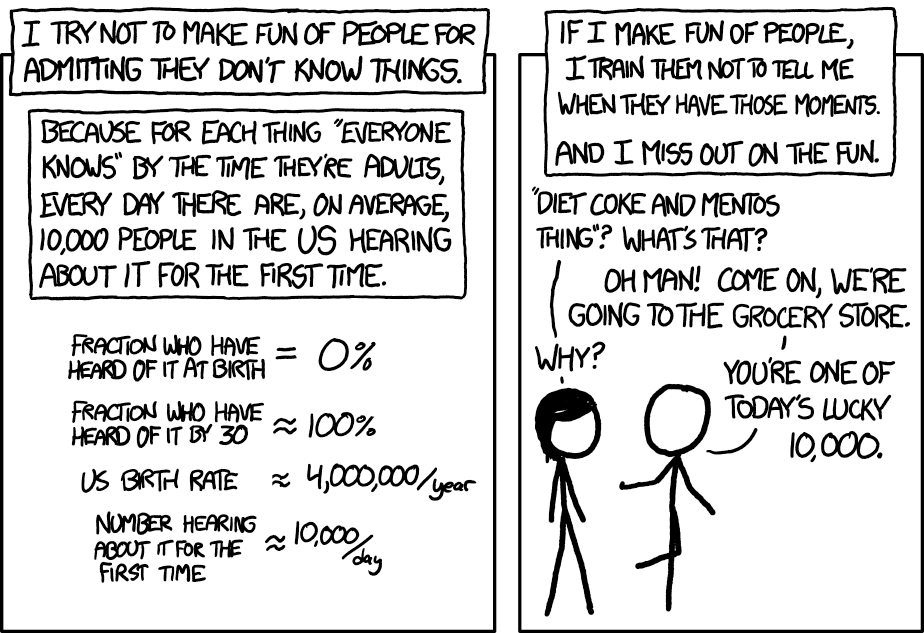
Watching a group of Year 7s sit through a lecture on gravity and black holes earlier this week as part of an outreach event made me feel almost envious. They weren’t afraid to give an answer and get it wrong, or even afraid to ask a question that might sound silly. They just blurted things out, no judgement attached. I couldn’t help but wonder, when did we lose that?
Maybe we forget that learning was for learning, not for exams or grades. I still remember telling my A-Level teachers, after almost every single exam, that I wanted to drop maths. I hated the process of assessment, and still do, and I’ve said the same thing to lecturers at university in the heat of the moment.
I keep myself this question so I propose is once more: how do I stop being afraid again?
I chose maths because I love it. So when did things change? When did I, and so many other kids, go from not caring what we said out loud to refusing to settle for anything less than perfect? I’ve found that the fear of being “assessed” in general bleeds into everything else too. Maybe it’s never really been about the maths, but the fear of making mistakes, and of being judged for them. As kids we don’t carry that weight as much, but at some point, the thing we love starts to hurt us.
Funny thing is, at the gym I find it much easier to take it easy on a bad day. Maybe that’s because the growth is for me, and only me. This makes me wonder if I’m even doing the exams for myself, and I feel like the answer of “not really” is more accurate that I’d like to accept.
I think it matters to hold onto the joy of doing something difficult, especially when the things you don’t enjoy start crowding everything else out. Don’t let other people’s opinions talk you out of the thing you love. However stressful exams get, the joy of doing maths for its own sake is always bigger than the fear. The dark thoughts get loud sometimes, but they’ve never been louder than the joy my 13-year-old self felt reading Logicomix, or the feeling of watching those Year 7s ask questions about an expanding universe, which took me straight back to watching Carl Sagan’s Cosmos in my room during lockdown. No exam will ever outweigh that, that’s a choice I get to keep making.
I’ve had lots of analogies from my helpful teachers and tutors that have carried me through the not so “fun” times. Everything from “there are no sabre-tooth tigers around” to Shakespeare in Love’s “I don’t know, it’s a mystery”. But at the end of the day, it was never about the exams. They’re nothing more than a toll booth one must pay, inevitably, for choosing to go on the beautiful journey of discovery in Maths. Annoying, expensive, occasionally awful. But you don’t drive the motorway for the toll booths; you drive it for where it’s going.
It’s not the exams that make me “me”. Everything around them does. The conversations with lecturers that wandered off-topic, the moments my attention drifted somewhere more interesting than the board. Exams are uniform; they measure one thing, and they didn’t can’t capture any of that. And if lived experience is what actually matters, exams barely scratch the surface. Looking back on this year, my results aren’t even close to the best things that happened.
I don’t have a cure for maths anxiety. What I have is being in the middle of it and just “feeling” it. Trying things and seeing how they land. Reframing “revision” as “experiments” has weight helped more than I expected. You don’t carry the same judgement into an experiment that you do into revision. Taking a break becomes data, not failure. Most of this is subconscious, so it’s hard to just believe it, but experimenting has certainly taken some of the weight off “performance,” at least for a bit.
Talking to people helps too. Chances are, anyone you look up to has felt exactly this at some point. Writing it down helps as well. It’s easy to feel alone with this in your head, but you’re really not. As humans we build an unhelpful link between performance and self-worth somewhere along the way. Every time things don’t go to plan and you turn out fine anyway, your brain files that away so next time, it isn’t the first time. Every time you do something “imperfectly” and below whatever unrealistic standard you set for yourself and nothing catastrophic happens, you cast one more vote in a long feedback loop. I keep telling myself that habituation will eventually work, hoping it sticks. It’s slow, and it’s sucky, and it’s difficult to just let it be sucky.
Maybe the point was never to stop being afraid, to answer and ask the questions despite what the fear might say the way an eleven year old does, before anyone’s taught them that some answers come with a grade attached. They haven’t hit the toll booths yet. I have, more than a few times, and I’m still working out how to drive past one without flinching. But it’s the same road, and I believe it goes somewhere good to keep going.