Let it (Not) Burn
I think my first memory of cooking involves burning pasta.
Bronze DofE practice expedition, some random field in Cerne Abbas in Dorset, and camping stove that looked like it had seen war. All I had to do was boil pasta, and I can vividly recall the dawning realisation that I had absolutely no idea what I was doing.
How difficult could it possibly be to burn pasta, you may ask?
As it turns out, not very if you are 15 and me. Because we were in a field in the middle of nowhere and I was too stubborn to admit defeat, I spent a good two hours scraping the charred remains off the bottom of the Trangia before bedtime.
That was my introduction to cooking. And that was the day I decided cooking was not for me.
The Obsession with Exactness
Fast forward a few years, I’m in my uni flat kitchen and I hear one of my flatmates say things like, ‘Just measure it by eye’.
Measure it by eye? What’s that even supposed to mean? First of all, which eye? How many grams? Millilitres? What is the acceptable tolerance?
I’m used to numbers, and I wanted numbers. I wanted exact quantities, ratios, instructions. I wanted someone to tell me it was ’73 grams of oats’ and not ‘a handful’; or ‘150ml of milk’, not ‘enough to cover’.
After all, I’m a mathematician, not an engineer, please don’t ask me to approximate things. There’s a reason I’ve spent months learning about limits and epsilon–delta definitions, and it’s not to be defeated by a mysterious culinary quantity known only as ‘a drizzle’.
There’s comfort in exactness. A theorem once proven does not wobble but cooking on the other hand, wobbles constantly, and it’s something I found more unsettling than I’d like to admit.
Somewhere between burnt DofE pasta and under-salted scrambled eggs, I realised that my discomfort with ‘measure by eye’ was more than just about food.
It was about needing to feel in complete control1 of things.
If I measured everything precisely, nothing, in theory, could go wrong. If I had the exact time, the exact quantity, the exact method, then I would know I’d done it right. Without a number, how do you know you’re correct?
The Joy (and Frustration) of Experimenting
Over the past few days, my lovely flatmate Gabz has been gently helping me dismantle this mindset, both in cooking and inadvertently, elsewhere.
One of the first things she said to me, and continues to remind me whenever I’m gripping a knife like it’s an exam paper:
“Remember, it doesn’t have to be perfect.”
I used to feel almost resistant to that, but lately, I’ve been allowing myself to experiment more.
And it’s been deeply frustrating.
I feel like there is a very specific kind of frustration that comes from not knowing whether something is correct, but having to proceed anyway. It feels inefficient, unstructured, risky. And yet, there is unexpected joy in that.
When something tastes better after you tweak it, that improvement feels earned. When you adjust seasoning and it works, it feels like you’ve understood something. I’ve started to enjoy the process of improving something one step at a time.
Cooking, as it turns out, is iterative. You adjust, taste, correct, and get better. I use the term iterative deliberatively here, sound familiar?
Newton-Raphson in a Frying Pan
This could not possibly be a MathsRant post without me sprinkling in something slightly nerdy halfway through.
In numerical analysis, we often want to find roots of some function f(x), i.e. solve for the values where f(x) = 0. And at times, there’s no neat algebraic solution, or closed form, or a satisfying expression you can box at the end.
So we approximate. And one of the most commonly taught methods in A-Level Maths is Newton-Rhapson. Without going into too much detail, you start with a guess for the root, look at how wrong you are, and use that information to improve the guess.
Under the right conditions, you converge really fast.
However, Newton didn’t just sit there knowing with absolute certainty that this would always work. The rigorous convergence proofs came later, whereas all Newton had was intuition, some geometric reasoning, and mostly experimentation. Draw a tangent line, see where it hits the axis, and try again.
The iteration came before the proof, and that’s what cooking has felt like for me. You don’t demand perfection at start, you move towards it. You just start somewhere, adjust, and repeat.
Now unless, of course, your initial guess is catastrophically wrong, in which case you end up my DofE pasta.
So just start somewhere, trust the iteration, and let it cook2.
On Perfectionism
Sometimes, learning mathematics feels like it was perfect and precise right from the beginning, as if Euler seemed to have entered the world proving identities in polished LaTeX.
It all looks inevitable, but that’s not how mathematics actually happens.
Before there is a clean proof, there are guesses, before there is a theorem, there is intuition. And before convergence, there are wildly inaccurate starting points.
We just don’t see that part. And when you’re learning maths, that illusion can be dangerous. It makes it feel like if you don’t understand something immediately, you’re behind, or that if your first attempt isn’t perfect or the most efficient, you’re not cut out for the subject.
Cooking, unexpectedly, has helped me see through this and has become a healthy distraction. Not because it’s perfect, but because it isn’t.3
Big thank you to my awesome flatmates for tolerating me the past few days as I’ve been attempting to cook meals while not burning down our kitchen, and for helping me meal plan and constantly giving me tips on how to cook. At some point in the future, I hope to treat you all with the skills I have learned from you.
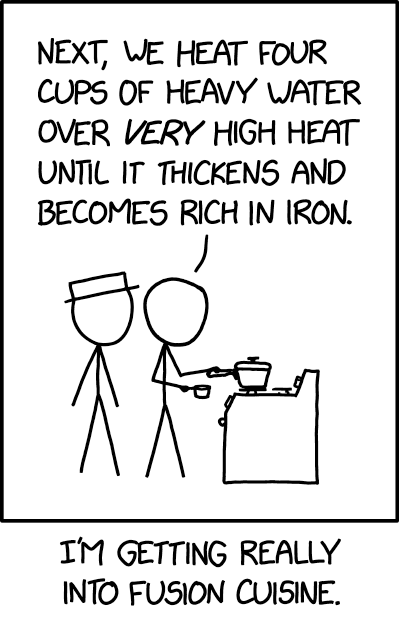
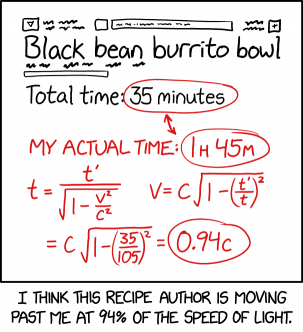
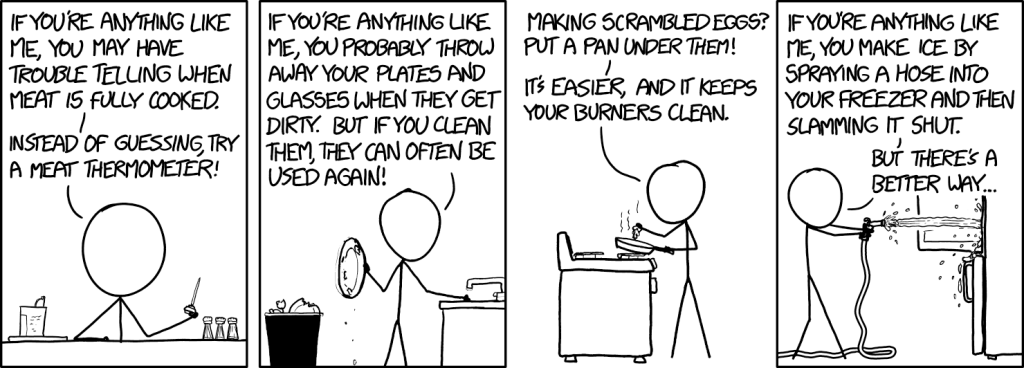
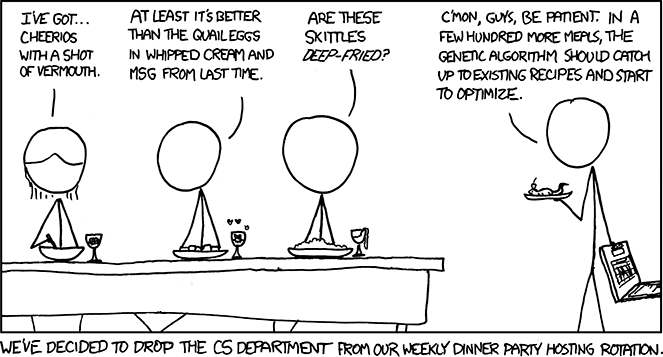
I had a lot of fun writing this post, and I hope you did too reading it. As usual, find attached a selection of xkcd!
- To read about another rant on (lack of) control, visit this post ↩︎
- Pun entirely intended ↩︎
- I still maintain that cooking is fundamentally a science rather than an art. There are chemical reactions occurring whether you ‘measure by eye’ or not. I remain open to debate, but Lessons in Chemistry has only strengthened my position. ↩︎


and yet even with a ’73 grams of oats’ instruction I still require a balance that gives at least two decimal places (permanently borrowed from a relative’s lab) to ensure that not a single particle is missing
LikeLiked by 1 person