Why every Maths topic should come with a problem, a person, and at least one slightly cursed backstory
I feel like there is something to be said about the kind of sadness that comes from opening a page of mathematics and feeling… absolutely nothing. Not confusion, exactly, but that strange feeling that arrives when you are looking at something which is probably very beautiful, and yet currently feels about as thrilling as watching paint dry in real time.
You see a theorem, then a proof, then an example. Then, if you are especially lucky, a problem sheet kindly designed to remind you that no, you do not in fact understand what is going on.
And the odd thing is that sometimes, much later, you discover that the topic is actually fascinating. Deeply fascinating, even. The kind of thing that would once have sent your younger self pacing around the room in excitement, but by the time you first met it in a formal setting, much of the life had already been scrubbed off it.
That, I think, is a shame.
This is not really a criticism of lectures or teaching, at least not in the simplistic sense1. Formal teaching has a very difficult job. It has to get through content, establish definitions, state results carefully, and somehow shepherd a room full of hopefully attentive students toward enough understanding to survive the exam and, ideally, remember something beyond it. There are time limits, and only so much room in a lecture before you must, regrettably, return to the matter of proving that something is well-defined.
And yet, mathematics did not descend from the heavens in perfect notation, neatly sectioned into definitions and lemmas and exercises 1 through 12.
It was made slowly, and often painfully, by people trying to understand something that would not leave them alone. That so much of what now appears to us as formal and inevitable once existed only as a stubborn little human hunch. A pattern someone noticed and could not stop thinking about. A question that kept a person awake at night. A line in a notebook. A mess, a gamble, or a guess.
If I were every writing maths notes, the kind I would actually want to read, I think I would want each topic to begin with four things:
- What problem was this invented to solve?
- Who is the cursed mathematician attached to this?
- What is the main conceptual or intuitive idea?
- Only then: the formal theorem
This isn’t because rigour does not matter. It absolutely does. Mathematics without rigour is how you accidentally invent nonsense with excellent notation. But I do think that by the time many students encounter a theorem, they are being shown the cleaned-up fossil of an idea without ever having met the living creature.
And there is a difference between those two experiences.
What problem was this invented to solve?
This, I think, is the first question too many notes forget to ask. A lot of mathematics feels arbitrary until you know what broke badly enough for someone to invent it.
Take complex numbers. If you are introduced to them only as ‘numbers of the form a+bi, where ,‘ then yes, that is technically correct. But it also sounds slightly like a prank. The obvious question is: why are we doing this? Why did humanity, already struggling perfectly well with ordinary numbers, decide to conjure an additional one whose square is negative?2
The same is true all over the subject. Calculus exists because motion is awkward. Fourier analysis exists because heat and sound and waves are inconvenient if you would like to understand them properly. Group theory exists because symmetry turns out to be much more powerful than it first looks. Linear algebra becomes a lot less random when you realise it is, in large part, a language for describing transformations, structure, and systems that refuse to stay standard in one variable.
A theorem without a motivating problem can feel like being handed a key without ever having seen the door. And that is not a very memorable way to learn.
I think this is one of the reasons so many good maths videos and informal explanations stick in the mind. They often have the freedom to linger on the why in a way formal teaching sometimes cannot. They can spend ten whole minutes building up the weirdness of a problem before introducing the elegant thing that solves it. And that matters, because curiosity is not a decorative extra in learning, it is often the thing doing most of the heavy lifting.
Who is the cursed mathematician attached to this?
Now, this may sound like I am simply advocating for more dramatic biographies in lecture notes, and to be fair, I am. But not only because it is entertaining, though it often is. Stories matter because human beings are absurdly good at remembering them.
You may forget the exact hypotheses of a theorem. You may even forget the notation. But you might remember that Évariste Galois effectively spent the last night of his life writing mathematics before dying in a duel at the age of 20, which is not, one suspects, what most people mean when they say they are ‘locked in.’
You might remember that Georg Cantor stared into infinity long enough to discover that there are, somehow, different sizes of it, or how Ramanujan often credited the goddess Namagiri with revealing formulae to him in dreams3or that Sophie Germain had to write under a male pseudonym just to be taken seriously.
And once you remember the person, you often remember the mathematics attached to them. This is not reducing mathematics to gossip, but recognising that knowledge sticks better when it is attached to narrative, conflict, personality, and stakes.
And mathematicians have historically been very good at generating all four.
It’s also important about being reminded that mathematics was made by people who were not all polished, serene, impossibly rational geniuses floating outside of ordinary life. They were often anxious, obsessive, eccentric, stubborn, socially catastrophic, politically constrained, broke, ill, ignored, overconfident, or all of the above.
What is the conceptual idea?
A good intuitive explanation does not replace rigour, but gives your brain somewhere to put the rigour when it arrives.
If the first time you meet a topic is in pure formal language, the mind tends to do one of two things. Either it retreats into vague ‘I kind of get the vibe’ territory, or it becomes very good at mechanically reproducing steps without really knowing what any of them mean.
The sweet spot, at least for me, is when someone first gives you the shape of the idea. That is what so many good maths communicators and videos capture beautifully. They often start not with ‘Let V be a finite dimensional vector space over a field F,’ but with something closer to: ‘Here is the strange thing this idea is trying to capture.’
The determinant stops being ‘that weird scalar you calculate by suffering’ and becomes a story about how a transformation scales area or volume, and in a similar vein, eigenvectors stop being mysterious exam objects and become directions that a transformation refuses to twist away from themselves.
The best explanations often let you feel the idea before forcing you to formalise it. And I think that feeling matters. It is often the thing that makes you care enough to keep going when the notation becomes cursed and the proof decides to consume three pages and your remaining will to live.
The Formal Theorem
The formal side of mathematics is not the enemy here. It is one of the reasons the subject is so extraordinary. Maths is not just beautiful because it has nice ideas; it is beautiful because those ideas can be made precise enough to trust.4
That is astonishing, if you think about it for too long. But I think the theorem lands differently when you have already met the problem, the person, and the intuition first.
And that is a much more satisfying thing to learn.
“But you can just find all of this on Wikipedia…”
Yes, of course you can. You can also find recipes online, and yet people still write cookbooks.
The point is not that this information is unavailable, the point is that curation matters. Wikipedia can tell you what happened. It can tell you dates and definitions and publication histories and names of people’s siblings. But it cannot always tell you which details actually illuminate the mathematics, or which part of the story is the one that makes the idea click in your head and stay there.
The internet is full of information. That is not the same thing as understanding. And I think one of the most underrated acts of teaching is not merely providing facts, but arranging them in the order that makes them memorable and meaningful.
If I ever end up writing proper maths notes for myself, or for anyone else, I think I want them to feel less like legal documents and more like invitations. Not less rigorous, just more human.
This post is also me making peace with the fact that I don’t learn this subject best when it arrives as a sequence of statements detached from all human context. I learn it best when it feels like someone, somewhere, once cared enough about a weird problem to chase it until it became beautiful.
And I suspect I’m not the only one.
So yes, I’m very tempted to start a small series on mathematician lore. Partly because the stories are excellent, and also because I think the stories are, in a very real sense, part of the learning mathematics too.
P.S – I often talk about the ‘beauty’ of maths. But it is a complicated thing. Beauty is in the eye of the beholder; there are plenty of intelligent and thoughtful people who don’t find maths beautiful or interesting. Not everyone will find the same ideas beautiful, and they don’t need to.
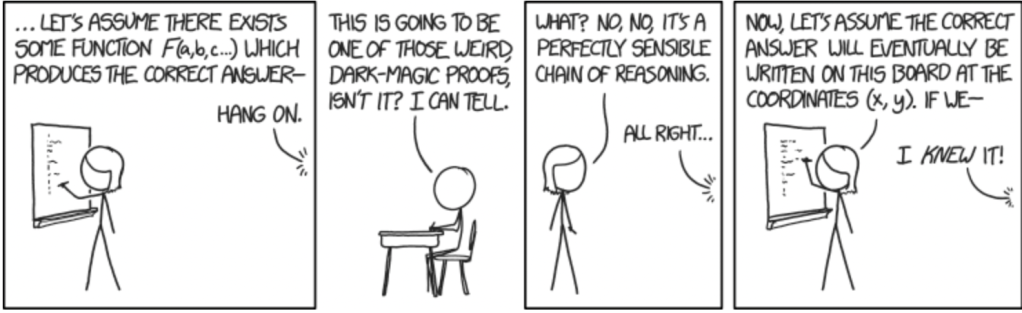
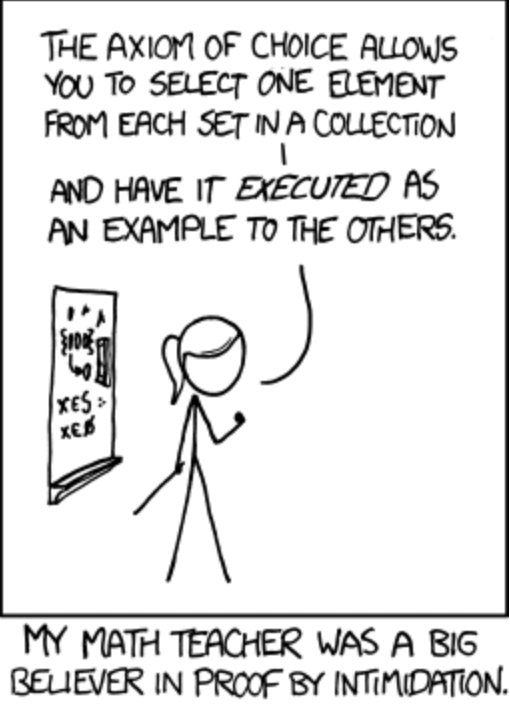
- I also feel like the issue rather than just a personal preference is the downstream effect. A lot of people leave formal maths education convinced they’re ‘not maths people,’ when what actually happened is they never met the subject on terms that made it feel worth engaging with. That’s a pretty significant loss, both for them and for the field. ↩︎
- It begins with exploring equations like , and later more complicated polynomial equations. There is a very good Veritasium video on this, which captures nicely just how much of mathematical history consists of people encountering a problem, declaring the existing rules insufficient, and then making the situation significantly weirder. ↩︎
- This is either one of the most poetic things ever said about mathematics, or a deeply unfair standard to set for the rest of us revising for exams. ↩︎
- I think that is part of what Paul Erdős meant when he spoke about The Book: the imaginary place where the most beautiful proofs already exist. ↩︎
 Maths Rant