One of the things I didn’t expect to miss at university was doing school maths challenges.
There is something very strange about sitting in front of a problem that does not immediately make sense. No obvious method, or a nice worked example hiding in the back of the book. Just your brain, a question that looks almost unreasonable, and the uncomfortable realisation that you are actually going to have to think.
When I was first introduced to maths challenges at secondary school, I did not want to study mathematics. I was far more interested in humanities and arts. I liked music, reading, writing, constructing an argument and defending it.
Mathematics was just another subject.
But maths challenges were different. They were not about memorising steps or applying the latest method we learned in class. They were about not knowing what to do, and choosing to stay with the problem anyway.
I vividly remember engaging with this one geometry problems in Year 10 from one the UKMT challenge papers. It involved triangles, angles chasing everywhere, lines that seemed important but probably were not. I must have drawn that diagram at least twenty times. Each version slightly different. Each time convinced I was close, and each time realising I was not.
I would label every angle I could find. Add lines that did absolutely nothing, and convince myself I had found something clever, only to hit another wall.
And it was very frustrating.
But that frustration was the point. Because when it finally clicked, it was the result of sitting in the confusion long enough for something to shift.
That feeling, that chase, that quiet moment where the chaos in your head rearranges itself into structure.
I later realised I loved mathematics less because I was reasonably good at it, and more because I fell in love with struggling with something long enough for it to become meaningful.
Looking back, I think that is what changed everything.
Maths challenges taught me things that were never written on the syllabus. They taught me how to sit with confusion without immediately panicking, how to break a big problem into smaller pieces, how to test an idea even if I suspected it might fail and how to start again without treating starting again as defeat.
And here’s the important part, none of those skills belong only to mathematics, they are thinking skills.
You do not need to want a maths degree to benefit from learning how to approach something you do not immediately understand. What stays with you is not a specific geometry trick, it is the patience, structure, resilience. The ability to sit there and think properly instead of searching for the fastest escape.
If I am honest, maths challenges probably shaped my degree choice long before I consciously realised it. I did not wake up one day and decide I wanted to study maths, I just noticed that the moments I enjoyed most were the ones where something difficult slowly became clear because I refused to give up on it.
And that feeling was enough.
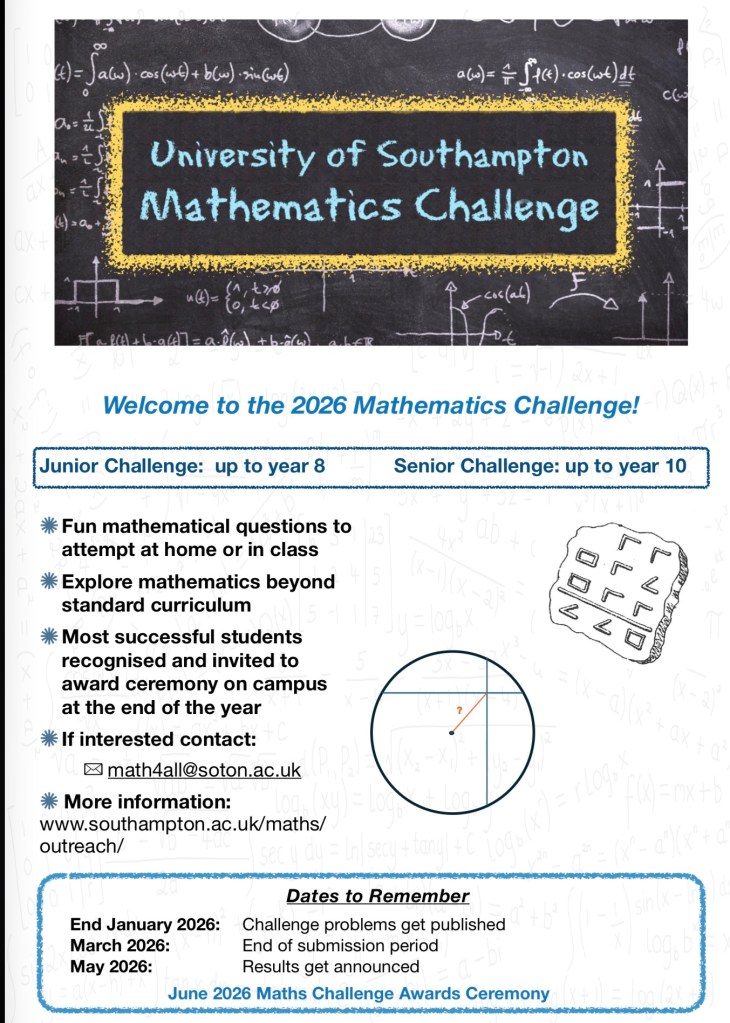
It always makes me happy to see opportunities for students to experience that same kind of thinking. The School of Mathematical Sciences at Southampton is currently running its Maths Challenge, encouraging exactly this sort of curiosity and persistence.
If you are a student who enjoys that kind of stretch, or a teacher who knows someone who might, details can be found in the image attached here. You do not have to want to study mathematics. You just have to be willing to struggle with something long enough for it to start making sense.
And sometimes, that is where everything starts.
 Maths Rant